How we use AI in software development
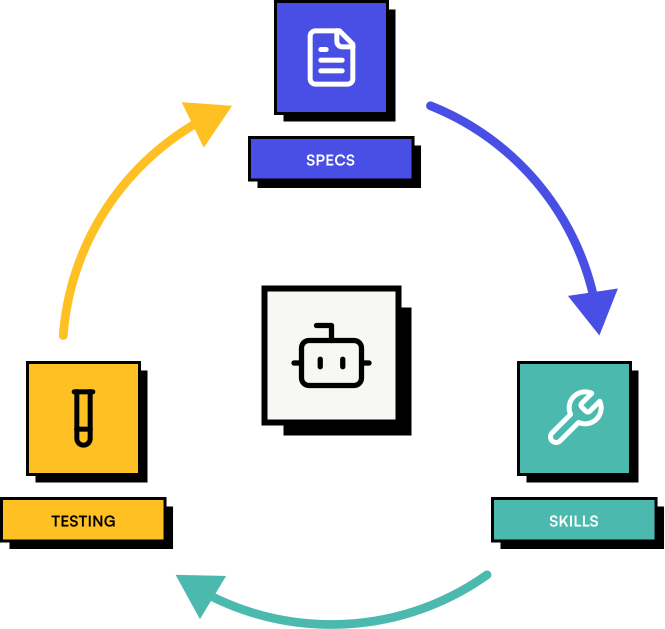
Our learning loop: specs, skills and tests
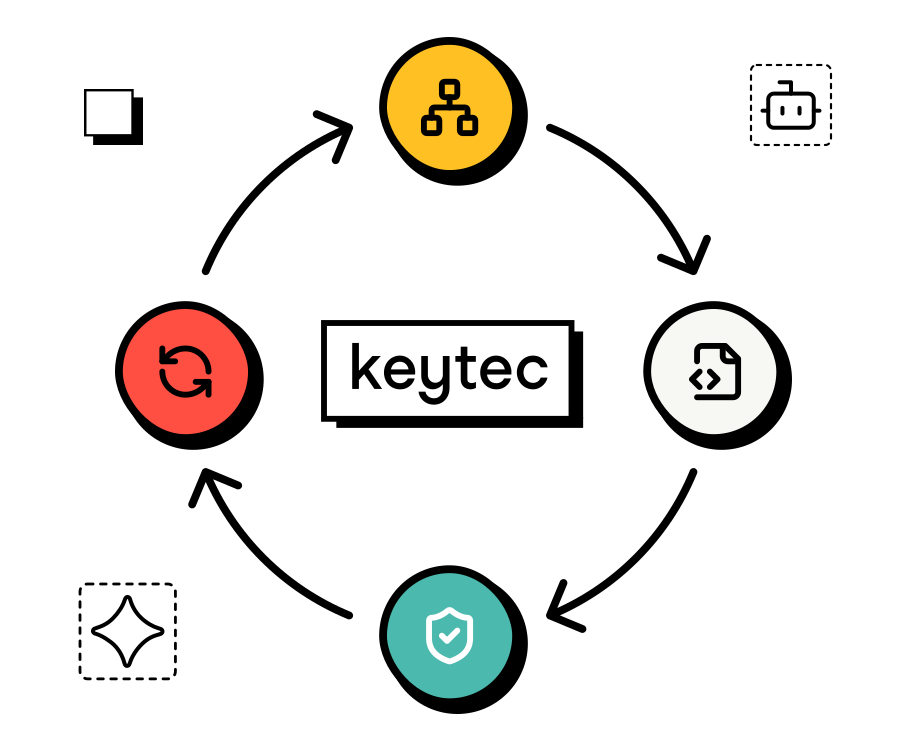
Artificial intelligence can speed up a lot in software development. At the same time, practice quickly reveals its limits: generated code often looks solid at first glance, but fails when confronted with existing dependencies, quietly grown project conventions, or a simple lack of verification. This is confirmed by the Fraunhofer IESE, which documents how "individual effectiveness" is increasingly becoming the focus — not just raw productivity gains.
That is exactly why we at keytec do not use AI as an isolated prompting tool. For us, it only becomes truly valuable when embedded in a controlled development process. At the heart of this is a learning loop made up of specs, skills and tests. Only this combination turns fast generation into reliable delivery.
Why generic AI-generated code falls short
Many teams are currently experiencing the same pattern: AI delivers results quickly, but in integrated reality they often do not fit cleanly into the project. Architecture guidelines get partially overlooked, conventions are not consistently followed, and implicit system knowledge is ignored.
Without feedback, this creates a cycle in which new code is generated repeatedly, without the system ever learning sustainably from it. The result is friction, rework and uncertainty. According to the GitLab DevSecOps Report 2025, 97% of respondents would use AI in development — but only 37% trust it without a human review. That tells the story clearly: speed alone is not enough.
For us, what matters is that AI in software development does not just produce code, but also learns from the project context.
Our learning loop: specs, skills and tests
Our approach is based on a self-improving system. Each iteration produces not only changes in the code, but also artefacts that feed back into the process. This way, the AI becomes more precise with every task.
1. Specs: What is being built?
Every requirement is formulated as a structured specification and anchored in the workspace after implementation. For us, these specs are the single source of truth across frontend, backend and integrations.
This does not just document what was built. With every feature, the project continues to specify itself. AI does not work in a vacuum but follows clearly formulated requirements.
2. Skills: How is it being built?
Architecture guidelines, coding standards and project-specific conventions are captured as machine-readable skills. This includes patterns, integration rules and technical guardrails.
When AI delivers something that does not fit the project, we do not just correct the output. We sharpen the underlying skill. This turns a one-off mistake into a systematic improvement of the process.
3. Tests: Was it built correctly?
Tests are not a downstream add-on for us — they are part of the feedback loop. End-to-end tests and unit tests help verify generated output immediately against real requirements.
This step is particularly critical: only when a system can verify its own output does a stable cycle of generation, checking and improvement emerge.
What this approach changes in practice
The difference for us lies not only in speed, but in the quality of repeatability. AI does not become a random generator with good days and bad days, but a tool that grows with the project context.
With a learning loop like this, AI in software development becomes:
- more precise in recurring tasks
- more reliable when working with existing project rules
- better aligned to real architecture and processes
- more controllable in review and quality assurance
This is especially relevant in complex Drupal projects, where technical requirements, editorial workflows, integrations, design systems and maintainability all intersect. Exactly in this environment, AI needs solid context rather than educated guesses.
Why this fits Drupal
Drupal projects are often long-lived, modular and deeply integrated into existing system landscapes. That makes them an ideal environment for a structured AI approach in software development. The Drupal AI Initiative shows how seriously the topic is now taken across the entire Drupal ecosystem: 28 organisations with more than 50 contributors are driving AI integration as a strategic priority.
Rather than producing quick one-off solutions, the goal is to build knowledge about requirements, standards and verification within the project itself. This fits our overall way of working: think sustainably, work in systems, and make technical decisions that remain sound over time.
If you would like to read more about how we position AI in the Drupal context, related topics include Drupal & AI, AI for content creation, AI-assisted translations as well as our services in Strategy & Consulting and Drupal Development.
AI needs control, not hype
We do not see AI as a replacement for architecture, review or accountability. Its strongest lever emerges where it is embedded in clear rules, testable requirements and transparent processes.
That is exactly why the learning loop matters so much to us. Specs capture what should be built. Skills define how it is built. Tests verify whether it was built correctly. Together they form a system that not only works faster, but gets better with every task.
Summary
At keytec, we use AI in software development where it creates real value: in a controlled development process that learns from requirements, rules and tests. The result is not a series of disconnected answers, but reliable outcomes that align with architecture, quality standards and project goals.
How keytec supports you
We show you what a structured AI approach can look like in your Drupal project: from spec architecture and project-specific skills through to test coverage. With our in-house team drawing on more than 15 years of Drupal experience, we support you technically and process-wise — from initial analysis to production rollout. You can find an overview of our services as a Drupal agency here.
More articles on AI


Do you want to develop sustainable digital projects?